01/The trap
Appearance can acquire authority too quickly.
Finished images, material palettes and natural cues are easy to read; acoustics, stress recovery, air quality and user control are harder to verify.
00In Brief / What You’ll Gain
Aesthetic quality matters, but it becomes dangerous when it is treated as proof. This essay separates the visual language of care from the environmental, operational and psychological conditions that actually support people in use.
01/The trap
Finished images, material palettes and natural cues are easy to read; acoustics, stress recovery, air quality and user control are harder to verify.
02/The evidence
Ulrich, Kaplan and workplace experience data point to measurable outcomes; not simply to the reassuring imagery of nature.
03/The structure
Procurement can buy finishes, furniture and feature planting more easily than it can buy concentration, recovery, intelligibility and perceived control.
04/The standard
If design claims wellbeing, restoration or performance, those claims should be testable, open to failure and able to survive occupation.
Proposals for new buildings and refurbishments need to stand up to scrutiny as realistic and practical means and not as ends in themselves. — Bordass, Leaman & Ruyssevelt, Assessing building performance in use 5 (2001)
A workplace can look intelligent long before it proves that it is. This is one of the reasons so many underperforming offices continue to be described as successful. Visual quality is immediate. It photographs well. It reassures clients, leadership teams and project stakeholders that money has been well spent.
It signals intent. A refined palette, generous planting, warm timber, soft furnishings, sculptural lighting and carefully branded communal spaces all communicate a recognisable message: this is a workplace that cares about people.
Sometimes that message is true. Often, however, it is only partially true. The workplace may look calm while sounding chaotic. It may appear healthy while delivering poor air quality, inconsistent thermal comfort and inadequate sensory control. It may borrow the visual language of restoration while failing to provide the conditions required for concentration, recovery or meaningful choice. In these cases, aesthetic quality does not reinforce performance. It substitutes for it.
That substitution is the aesthetic trap. — On image and performance
The trap is not that aesthetics do not matter. They do. Preiser and Vischer's performance hierarchy1 is useful precisely because it does not treat aesthetic or psychological satisfaction as a superficial extra, but as the upper tier of workplace obligation built upon more basic tiers of health, safety and functional performance. That is the nuance often lost in crude critiques of image-led design. The problem is not that aesthetic experience is irrelevant, but that it is too often delivered as a capstone without the structure beneath it; or worse, mistaken for evidence that the lower tiers are already working. A workplace may feel refined, coherent and desirable while still failing on the more fundamental question of whether it supports the people expected to use it every day.
This confusion is built into the way many workplace projects are discussed. Design discourse tends to privilege the visible. Materials, furniture, styling and atmosphere are legible to non-specialists in a way that ventilation rates, acoustic conditions, glare control, speech intelligibility or stress recovery are not. A client can walk through a completed office and form an instant opinion about whether it feels premium, contemporary or aligned with brand values. They are far less able to judge, on sight alone, whether the meeting rooms will be chronically overbooked, whether background speech will erode concentration, whether afternoon CO₂ levels will impair alertness, or whether the planting strategy is biologically appropriate to the light levels and maintenance regime available.
In practice, this gives appearance a structural advantage over performance. What is seen early, easily and publicly tends to dominate what is measured later, imperfectly and rarely.
Leesman's findings help explain why this matters.2 Their workplace experience model distinguishes between doing, seeing and feeling. Within the "seeing" category, general décor is a strong driver of employee sentiment and corporate image. That is important, but it is also revealing. Aesthetic quality has real influence over how people interpret a workplace and what they believe it says about the organisation. The risk is that organisations stop there. They invest heavily in what shapes perception while underinvesting in what shapes capability. In other words, they optimise for what the workplace appears to say, not for what it actually enables.
That distinction matters most when the workplace is being asked to support human performance rather than merely represent organisational identity.
A high-performing workplace is not one that successfully signals wellness. It is one that makes cognitively and physiologically useful conditions more likely. It helps people regulate attention, manage stress, recover from overload, work without excessive friction and choose between settings that actually differ in meaningful ways. These are not outcomes that can be guaranteed by aesthetic refinement alone. They depend on the interaction between environmental conditions, space planning, operational management and user control over time.
This is why the evidence base underpinning biophilic design is so often misunderstood. The most persuasive research in this field is not research about taste. It is research about outcomes. Ulrich's 1984 study3 did not show simply that people preferred trees aesthetically; it showed that patients with a view of trees had shorter post-operative stays, required fewer strong analgesics and received fewer negative evaluative comments in nursing notes than those facing a brick wall. His later stress recovery work similarly argued that even brief exposure to natural settings could support faster physiological recovery after stress. The Kaplans' Attention Restoration Theory4 sharpened this further by identifying four properties of restorative environments: being away, fascination, extent and compatibility. None of these are reducible to decoration. They describe conditions that help restore directed attention and reduce cognitive fatigue.
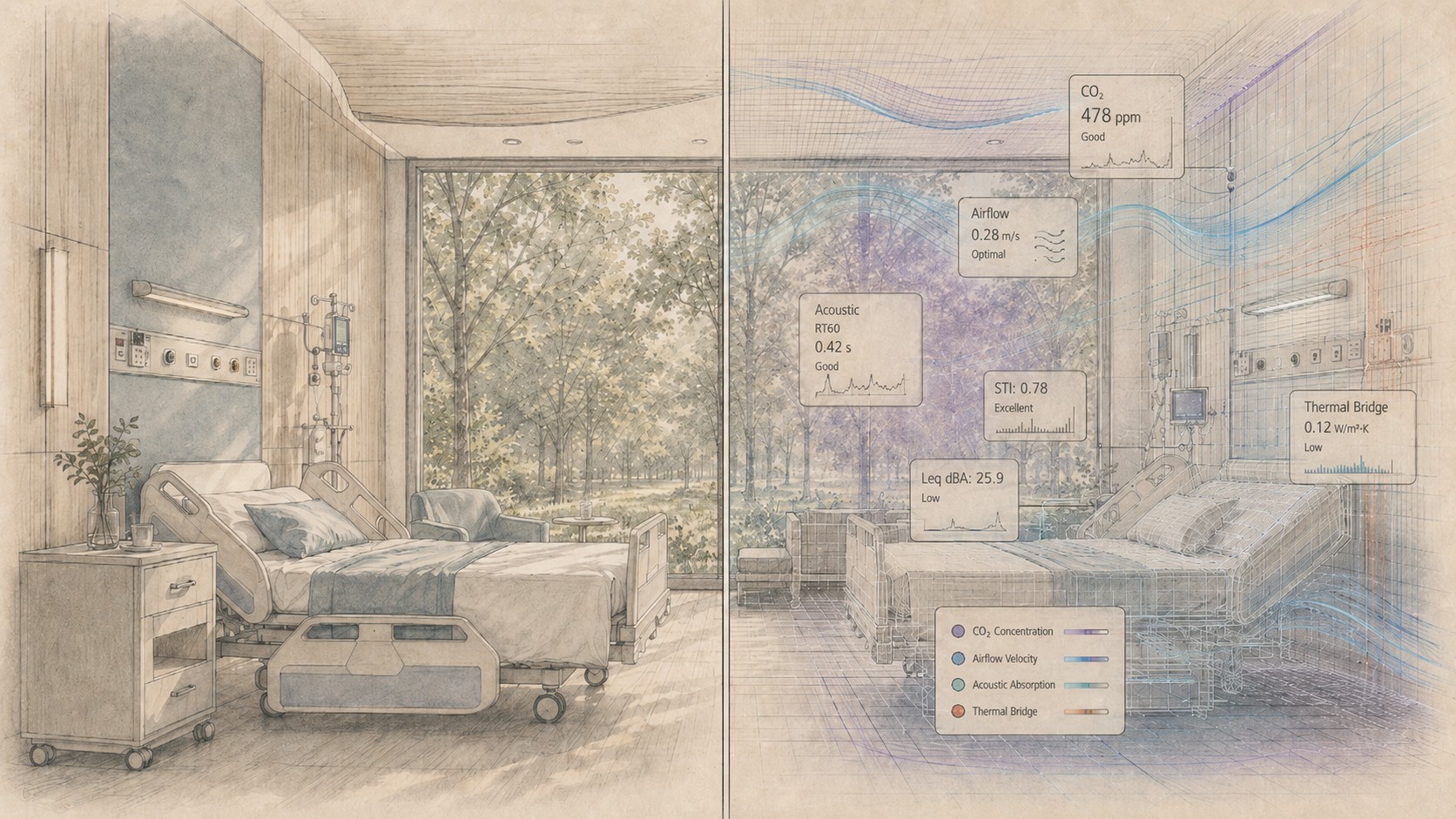
That is where mainstream workplace biophilia often goes astray. It adopts the imagery of nature more readily than the mechanisms.
A moss wall in a reception area may photograph beautifully and contribute to brand differentiation. It may also do almost nothing for the day-to-day cognitive experience of staff if the rest of the workplace remains acoustically harsh, visually fatiguing, spatially rigid and psychologically demanding. Exposed timber, earthy colours and abundant planting may soften perception of a space without materially improving its thermal stability, its air quality, its support for focused work or its capacity to offer genuine refuge from stimulation. A workplace can therefore look biophilic while functioning in an anti-restorative way.
The difference between expressive and functionally restorative design is not theoretical. It is practical. A planting installation in a circulation zone may express a commitment to nature without changing how work is actually experienced. By contrast, a small refuge space with controlled light, acoustic separation, soft visual complexity, comfortable enclosure and some degree of user control over occupancy or sensory exposure may directly support decompression, recovery and concentrated thought. Likewise, a timber finish may make a space appear warmer; but daylight modulation, reduced glare, quieter background conditions and a choice between open and enclosed work settings are more likely to determine whether the space is genuinely usable over time. The point is not that visible natural elements are irrelevant, but that they are only performance-led when they are part of a setting that changes what the user can actually do, tolerate or recover from.
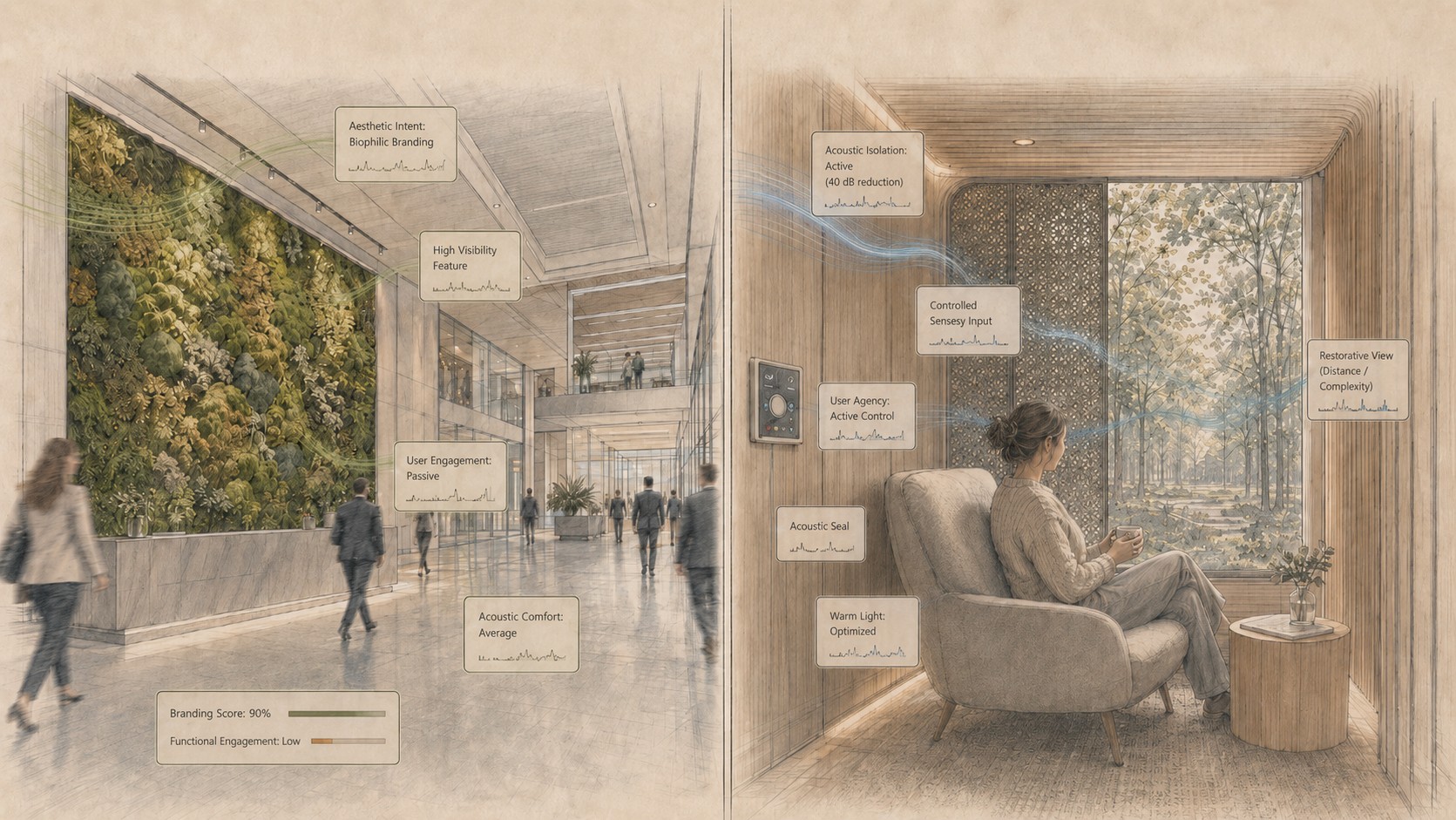
The reason the expressive version dominates is not difficult to understand. Style is easier to procure than behaviour change. It is easier to specify natural finishes than to establish a serious performance brief. It is easier to install planting than to redesign the acoustic logic of an open-plan floorplate. It is easier to market a green wall than to commit to long-term maintenance, post-occupancy evaluation and operational adaptation. The visible elements of biophilic design fit comfortably within existing procurement habits. The invisible disciplines required to make those elements effective often do not.
This is where the aesthetic trap becomes a governance trap.
Procurement systems are generally far better at rewarding the delivery of visible, specifiable outputs than the achievement of invisible, variable conditions in use. Finishes, furniture, feature planting, joinery and branded touchpoints can be described, costed, signed off and photographed. Concentration, recovery, intelligibility, sensory tolerance and perceived control are much harder to procure because they are not objects. They are outcomes arising from relationships between briefing, design decisions, commissioning, management and occupation over time. The conventional project structure therefore makes it easier to buy the appearance of care than the conditions of care.
It is easier to buy the appearance of care than the conditions of care. — §04 / On procurement
This matters because it helps explain why well-intentioned projects so often drift toward image. It is not only that clients or designers are seduced by style. It is that the project machinery itself is better organised around tangible deliverables than around monitored human outcomes. A procurement route can require the installation of biophilic features; it is much less likely to require evidence that these features improved cognitive restoration, reduced stress or supported different modes of work six months after occupation.
This is also where the continuity with the wider lifecycle problem becomes clear. As Chapter 1 argued, the industry still places disproportionate emphasis on the stages leading to handover, while the real test of workplace quality emerges during use. The RIBA Plan of Work formally includes Stage 7, but in practice that stage rarely carries the same commercial or cultural weight as briefing, design and delivery. The result is predictable. It is easier to fund what can be drawn, priced and installed before completion than what must be tested, tuned and learned from afterwards. Aesthetic features thrive under those conditions because they are legible at the point where projects are judged most publicly. Performance conditions do not, because they reveal themselves more slowly and require an ongoing feedback structure that many projects never build.
In that sense, the aesthetic trap is not simply a design failure but an institutional failure of follow-through. The same applies to indoor environmental quality. Nobody experiences formaldehyde, nitrogen dioxide or carbon monoxide as aesthetic issues. Nobody complains that a workspace is visually over-concentrated in VOCs. Yet these are precisely the kinds of conditions that determine whether an interior is healthy in any meaningful sense. Indoor environments can expose people to pollutants at levels of health concern even when nothing appears visibly wrong. That should have been enough, by now, to dislodge the assumption that visual impression is a reliable proxy for environmental quality. It has not.
A governance response would therefore mean more than asking designers to be less superficial. It would mean changing what is commissioned, what is reviewed and what counts as project success. Human performance outcomes would need to appear in briefs as serious criteria rather than rhetorical aspirations. Post-occupancy evaluation would need to be treated as part of project completion rather than an optional extra. Facilities management and operational teams would need to be involved earlier, because many conditions that determine whether a workplace remains restorative are maintained, adjusted or undermined after handover. The WHO's healthy workplace model5 is useful here because it defines workplace health across physical environment, psychosocial environment, personal health resources and the organisation's wider relationship to community. That framing reinforces the central point: workplace wellbeing is not an atmospheric quality but a produced condition arising from multiple interacting systems. Most importantly, responsibility for in-use outcomes could no longer disappear into the usual gaps between client, consultant, contractor and operator. If a workplace is claimed to support wellbeing, focus or restoration, someone must be accountable for testing whether it does.
The deeper problem is cultural. The property and design industries remain unusually susceptible to the authority of finished images. Renderings, launch photography and award submissions all privilege the moment before occupation or the carefully staged version of it. A completed workplace is most publicly legible when it is clean, controlled and underused. It is least legible in the conditions that matter most: a wet Tuesday afternoon, at full occupancy, with simultaneous calls, competing temperature preferences, pressure on meeting space, variable daylight and the accumulated wear of actual use.
Aesthetic judgement is therefore often formed at exactly the point when the building is least able to reveal its performance. — §05 / On finished images
That bias can persist long after handover. Staff may continue to describe a workplace as impressive or attractive even while quietly working around its failures. They may feel proud to bring visitors into it while avoiding certain areas themselves. They may interpret discomfort as the price of a premium environment, particularly in organisations where image, status or cultural fit are strong. Under those conditions, beauty becomes not merely a mask for poor performance but a mechanism for normalising it.
This is particularly acute in open-plan workplaces, because these environments are often designed to read as lively, connected and contemporary. They can succeed visually and socially while failing cognitively. Leesman's post-occupancy analysis of new workplaces found that many projects improved interaction but continued to fall short in supporting individual and concentrated work. This is precisely the kind of failure that polished aesthetics can conceal. A workplace may feel energetic, generous and collaborative, while still being a poor instrument for the kinds of focused effort on which much knowledge work depends.
To say that is not to dismiss the symbolic value of beauty, nor to deny the genuine pleasure people derive from well-composed interiors. It is to insist on a more demanding standard. If aesthetic decisions are justified in the language of wellbeing, restoration, focus or human performance, then those claims should be treated as performance claims and held to the same standard as any other. They should be testable. They should survive occupation. They should be open to failure. That standard would change the way many projects are briefed.
It would mean asking, at concept stage, not only whether a space feels calm, natural or premium, but what specific mechanisms are expected to support that feeling and whether they are likely to hold under real conditions of use. It would mean distinguishing between elements that are primarily expressive and elements that are functionally restorative. It would mean treating planting as part of an environmental strategy, not a decorative afterthought. It would mean understanding that prospect, refuge, daylight variation, acoustic softness, thermal stability and sensory choice are not aesthetic luxuries but part of the infrastructure of cognitive performance.
Most of all, it would mean accepting that visual success is the beginning of the question, not the end of it.
The most persuasive workplace is not necessarily the most supportive one. In a market increasingly fluent in the imagery of wellness, sustainability and biophilia, the resemblance to care can too easily stand in for care itself. A workplace should not be praised simply because it resembles the idea of wellbeing. It should be judged by whether it helps produce it.
That is the distinction the industry still struggles to hold. Until it does, aesthetic quality will continue to obscure performance questions that should have been central from the start.
— End of Chapter 2. Next in the volume: The maintenance gap — how operational reality undermines design intent.
RReferences & Sources
Aesthetic and psychological satisfaction framed not as a superficial extra, but as the upper tier of workplace obligation built on health, safety and functional performance.
Workplace experience model distinguishing what a workplace enables, how it is perceived, and how it shapes mood and belonging.
Evidence base for biophilic design rests on measurable physiological and clinical outcomes; not on the imagery of nature.
Four properties of restorative environments: being away, fascination, extent and compatibility; none of which are reducible to decoration.
Four-dimension model: physical environment, psychosocial environment, personal health resources and enterprise community involvement.
Epigraph. Proposals for new buildings must stand up to scrutiny as realistic means, not as ends in themselves.
07Journal / Thinking
Coming soon·Essay 03
Why the factors that most undermine occupant satisfaction are often inherited after handover; and why maintenance is part of design performance.
Notify me →Previously·Essay 01
The opening chapter establishes the governance and accountability gap that allows underperforming offices to be described as successful.
Read chapter 1 →Send the brief, concept images, a plan, or a few photographs. We can help you test whether the planting, environmental conditions and operational reality are likely to support the claims being made.