01/The problem
Design success is often judged too early.
Launch-day images, delivery milestones and brand alignment can obscure how a workplace actually supports concentration, recovery, collaboration and everyday use.
00In Brief / What You’ll Gain
Most workplaces are judged at the wrong moment and by the wrong evidence. This essay explains why performance in use is the missing measure; and why biophilic design needs governance, not just visual language.
01/The problem
Launch-day images, delivery milestones and brand alignment can obscure how a workplace actually supports concentration, recovery, collaboration and everyday use.
02/The evidence
Post-occupancy research, workplace experience data and environmental psychology all point to the same issue: lived experience is rarely governed with enough care.
03/The biophilic trap
Plants, views and natural materials matter when they support specific human outcomes; they underperform when treated only as atmosphere or visual reassurance.
04/The takeaway
The essay reframes workplace design around performance over time; what people can do, how they feel, and whether the environment continues to support them in use.
Most workplaces are not designed, delivered or managed as environments for human performance. They may be efficient to procure. They may photograph well. They may satisfy brand ambitions, leasing expectations or sustainability checklists. Once occupied, many fail in the ways that matter most.
They do not consistently help people think clearly, regulate stress, sustain focus, collaborate well, or leave work with more energy than they brought into it. This is the central contradiction of the modern workplace. Organisations invest heavily in space, but far less in understanding how that space performs in use.
Leesman's survey of more than 1.36 million employees across over 9,300 workplaces in 122 countries makes that failure visible at scale: only 57 per cent of respondents agreed that their workplace enabled them to work productively.1 That figure is worth sitting with. In well over four out of ten cases, a building whose sole purpose is to support work fails, by its occupants' own account, to do so.
That gap is not simply a design problem. It is also a management problem, a measurement problem, and ultimately a governance problem.
For decades, the property and design industries have judged success too early. A project is considered successful when it is delivered on programme, on budget and to the required visual standard. In commercial terms, this is understandable; delivery milestones are visible and attributable, while operational outcomes emerge more slowly, are messier to interpret, and are harder to pin on any one decision. But for the people expected to work in these spaces every day, handover is not the end of the story. It is the beginning.
That is when the practical realities emerge. The meeting rooms that looked generous on plan prove impossible to book. The open collaboration area becomes a source of noise no one can escape. The planting looks impressive at launch but declines under poor light and indifferent maintenance. The building systems are either too rigid or too complicated to support changing patterns of work. The temperature drifts. Glare goes unmanaged. Air feels stale by mid-afternoon.
Staff adapt. They move desks. They wear extra layers. They bring in task lights or noise-cancelling headphones. They work from home when they need to concentrate. They learn which rooms are tolerable and which to avoid. Over time, these small acts of compensation become routine. The workplace appears to function because people keep adjusting themselves to its shortcomings.
In many organisations, this adaptation is mistaken for success. — On the cost of silence
People rarely complain in a sustained or organised way about environmental failure. The dissatisfaction is diffuse, hard to attribute, and easy to dismiss as personal preference. Buildings do not need to perform well to appear workable. They simply need occupants who are willing to absorb the friction.
This is not a new problem. The PROBE studies — Post-occupancy Review of Buildings and their Engineering, published in Building Research & Information in 2001 — surveyed sixteen well-regarded UK buildings two to three years after completion.2 These were not failed buildings. They had been designed with care, were often certified to recognised standards, and were selected because they were considered exemplary. What PROBE found was that actual energy use was often almost double the design estimate; that building systems defaulted to 'on' and stayed there; and that occupant satisfaction consistently fell below expectations on thermal comfort, acoustics and perceived control.
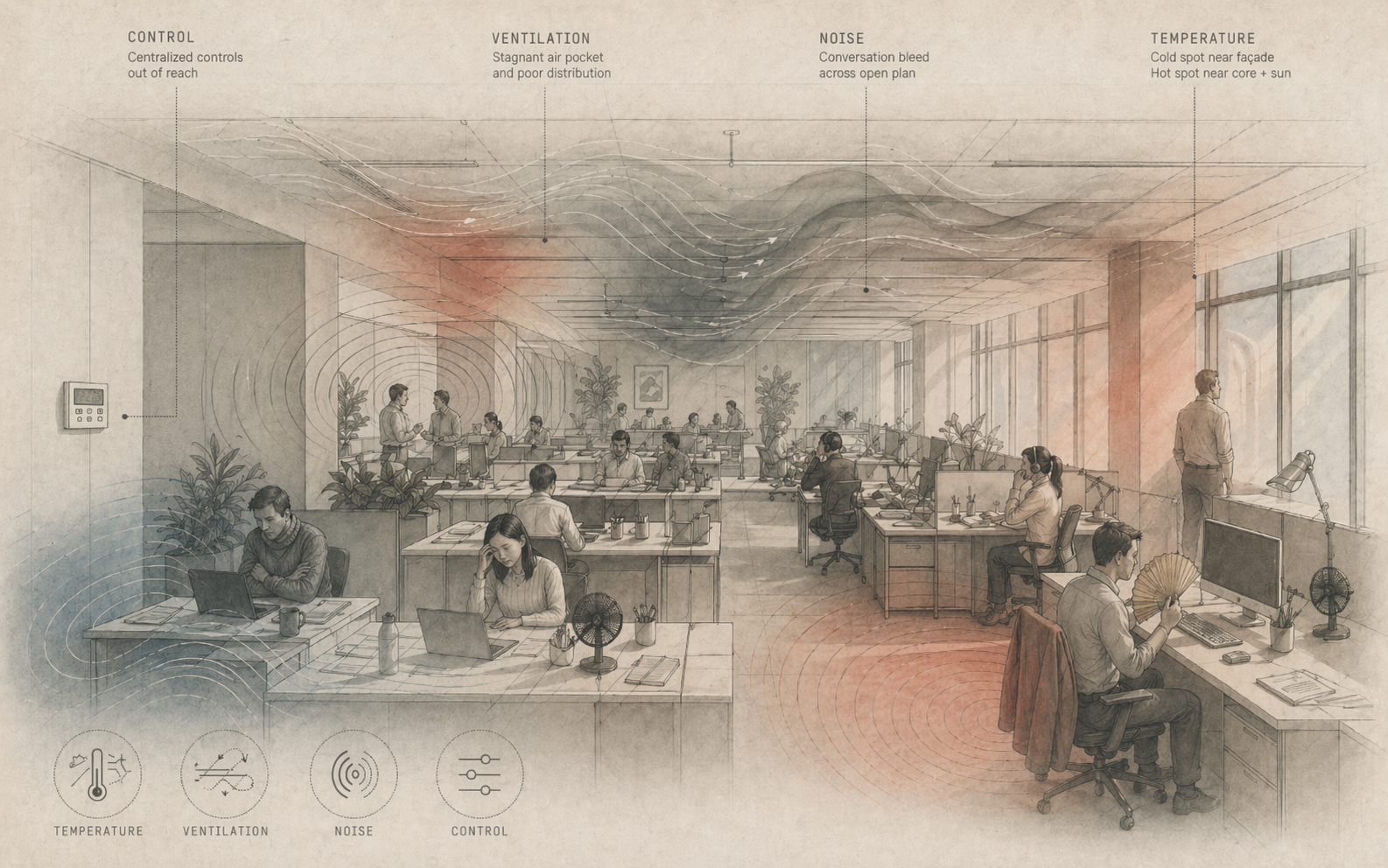
Bordass and Leaman also identified the conditions most responsible. Their 1999 paper 'Productivity in Buildings: The Killer Variables' showed that the factors most likely to undermine occupant satisfaction were not the ones attracting most design attention. They were mundane and operational: temperature control, ventilation quality, noise levels, and the degree of personal control over one's immediate environment. Not materials. Not aesthetics. Not the presence or absence of certification. The factors that most shaped whether people felt able to work were the ones most likely to be treated as FM issues after handover — if they were treated as issues at all.
Bordass and Leaman's conclusion in Paper 5 of the PROBE series named the underlying cause directly: the UK building industry's focus on production over performance-in-use had created a systemic accountability failure. That phrase is precise. It does not mean the people involved were careless or incompetent. It means the system was structured to reward delivery and remain largely blind to what happened next.
Underlying this is a structural failure in how the industry organises accountability. The RIBA Plan of Work — the standard UK framework for managing design and construction — has for most of its history treated handover as an endpoint. The project team hands over to the client. The client hands over to facilities management. FM inherits systems, finishes and live biological elements they may not fully understand, often without the documentation to explain key decisions and without the budget to deal with their consequences.
The 2020 revision made genuine improvements: a Plan for Use Strategy, measurable post-occupancy targets, and a circular rather than linear diagram to emphasise lifecycle thinking. But improvements to a procurement framework are not the same as improvements to practice. The financial model still rewards delivery. Architects are typically paid to produce drawings and specifications; their fee structures rarely support sustained engagement once a building is occupied. Contractors build to specification and move on. The result, as Preiser and Vischer argued in Assessing Building Performance,3 is that accountability for lived experience becomes nobody's job in particular — distributed so broadly across disciplines and contractual boundaries that it effectively disappears.
Their Building Performance Evaluation framework addressed this directly, spanning six phases of the building lifecycle, from strategic planning through to long-term facilities management review. Preiser and Vischer framed building performance as a hierarchy of obligation: first, health, safety and security; secondly, functional efficiency and fit for purpose; and thirdly, psychological comfort, satisfaction and meaning. The key insight was not methodological but moral: a building that does not poison or injure its occupants has not thereby succeeded. Those lower tiers are necessary, but not sufficient. A workplace that is safe yet functionally frustrating, or functional yet psychologically depleting, is still underperforming. Most buildings are held accountable only for the first.
Leesman's benchmark makes the scale of that failure visible. Their wider workplace experience model is useful here because it distinguishes between doing, seeing and feeling: what a workplace enables people to accomplish, how it is perceived, and how it shapes mood, belonging and experience. That distinction matters. It shows that visual and symbolic qualities are part of workplace performance, but cannot stand in for practical capability.
Across 1.36 million survey responses, 67 per cent of employees agree that their workplace positively affects their wellbeing. In Leesman's top-tier buildings — those achieving Leesman+ status — that figure rises to 81 per cent. The gap between average and excellent is not marginal. It represents millions of people working every day in environments that are, by their own assessment, working against them.
The features people rate as most important — and most consistently inadequate — are not the visible ones. Air quality shows the widest gap between importance and satisfaction of any factor in the survey. It is nearly universally considered critical. It is nearly universally rated as poor. This is not a design failure in any obvious sense: no one specifies bad air quality. But it is a failure of follow-through, operations and feedback: the very mechanisms that should identify and correct the problem before it disappears into familiarity.
The WHO's Healthy Workplaces: A Model for Action (2010) puts the same point in harder terms.4 It estimates that two million people die each year from occupational accidents and work-related illness, and attributes 8 per cent of the global burden of depression to occupational risk factors. Its definition of a healthy workplace spans four dimensions: physical environment, psychosocial environment, personal health resources, and enterprise community involvement. Workplace health is not a property of the building alone. It is produced by the relationship between the building, the organisation that runs it, and the people who use it.
The performance gap is fundamentally a governance failure. That needs unpacking, because it is easy to hear as an accusation. It is not, primarily, that. It is a description of a structural condition.
Here, governance means the systems by which organisations set objectives, allocate responsibility, measure outcomes, and learn from results. In most organisations, these systems simply do not extend to the relationship between physical environment and human performance. Capital decisions about workplace fit-out are made using payback models with no line for cognitive performance or staff wellbeing. Design briefs focus on density, specification and aesthetic alignment with brand values. Post-occupancy evaluation, where it happens at all, tends to be a one-off exercise in the first year of occupation — before the building has revealed its full range of failure modes, and usually as a compliance exercise rather than a genuine feedback mechanism.
No one actor is fully accountable for the lived experience of the workplace once the ribbon has been cut. That is the accountability gap. — §05 / The governance failure
The result is a system optimised for production and almost entirely blind to performance. Buildings are delivered. Certifications are obtained. Awards, occasionally, are won. And then the people who were supposed to benefit arrive on Monday morning and find that the air conditioning is either too cold or not working, the acoustic environment makes concentration difficult, the meeting rooms are fully booked, the informal spaces are either empty or dominated, and no one seems to be responsible for any of it. They adapt. They cope. The workplace appears to function.
This matters even more now than it did a decade ago. For much of the twentieth century, the office was a default setting. Attendance was expected; the workplace did not need to justify itself every day. That is no longer true. In many sectors, people now have some degree of locational choice. The office must now compete not only with other offices, but with home, third spaces and the autonomy people have come to value. A workplace that merely avoids failure is not enough.
The specific challenge for biophilic design is that it is unusually vulnerable to this kind of failure, and unusually prone to being claimed as a solution before the harder work has been done.
Nature is often used in workplace design as a visual signal of care rather than as a serious performance strategy. Planting becomes decorative rather than environmental. Natural materials are specified for atmosphere rather than performance. Green walls are photographed, publicised, and then left to facilities teams with no meaningful integration into operational strategy. The result is a familiar pattern: the language of wellbeing is adopted, but the systems of accountability remain unchanged. Organisations commission the appearance of a high-performing workplace without committing to the disciplines required to make one function.
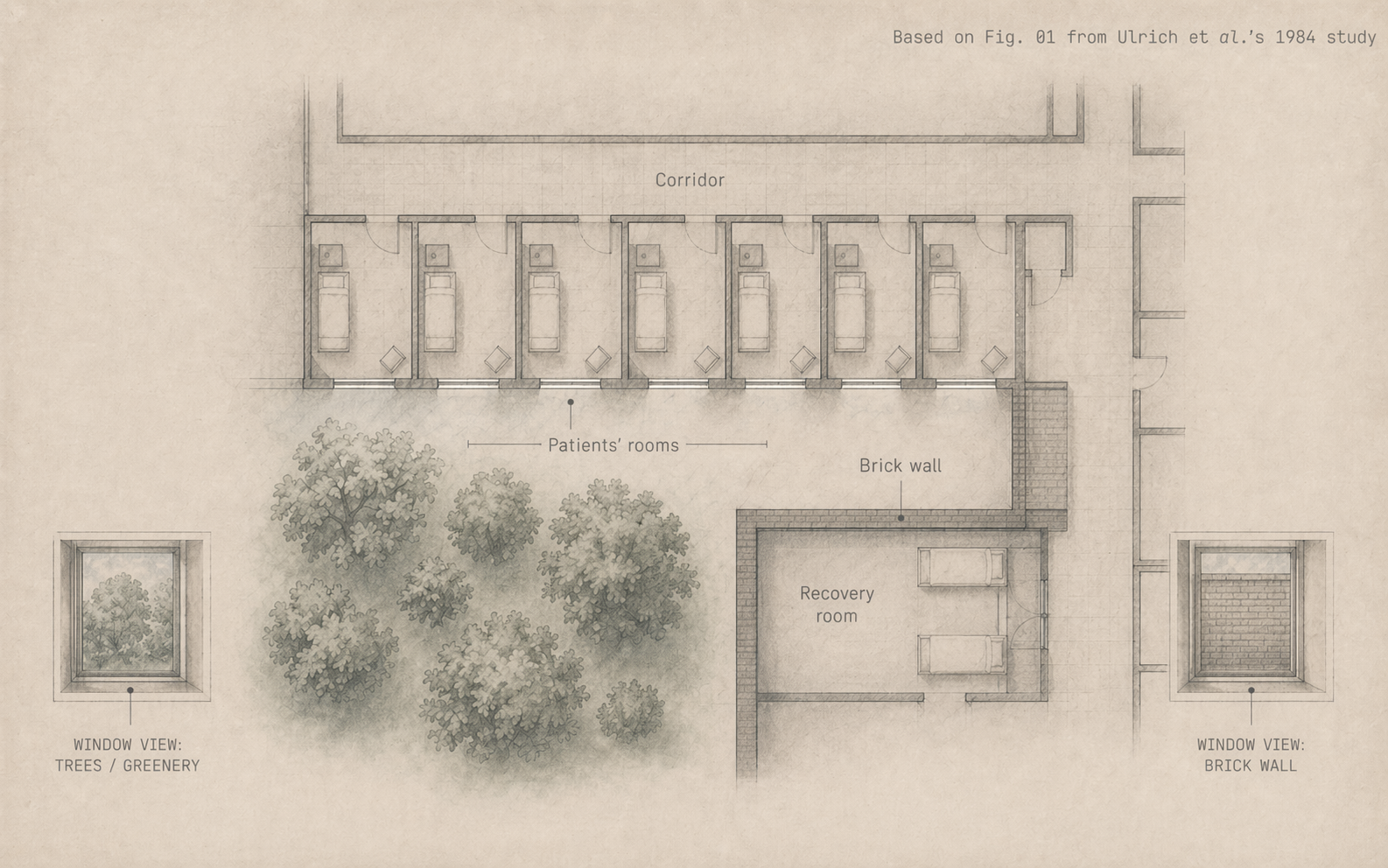
That distinction is crucial, because the evidence base for biophilic design is not about appearances. Roger Ulrich's landmark 1984 study found that surgical patients with a view of deciduous trees had shorter hospital stays, required fewer analgesics, and generated fewer negative nursing notes than matched patients facing a brick wall.5 This was not a finding about aesthetics. It was a finding about measurable physiological and psychological outcomes: recoverable in clinical data, replicable, and specific.
Ulrich's subsequent work on Stress Recovery Theory went further, showing through physiological measures such as heart rate, muscle tension and skin conductance that recovery from stress after nature exposure was significantly faster and more complete than recovery in urban environments, occurring within approximately four minutes. The implication for workplace design is precise: brief, well-designed exposure to natural elements can produce measurable reductions in physiological stress. Not mood improvements. Not aesthetic satisfaction. Measurable reductions in the biological markers of stress.
Rachel and Stephen Kaplan's work on Attention Restoration Theory introduced a complementary framework, identifying four properties of a genuinely restorative environment: being away, fascination, extent and compatibility.6 These are not properties that a material palette delivers automatically. They require space planning, acoustic design, lighting quality and an understanding of how different cognitive states need different environmental conditions. A heavily branded office with exposed timber cladding and a statement moss wall may satisfy a client's aesthetic brief while registering poorly against Kaplan's four criteria.
This is the fault line that runs through the industry. Biophilic design, as it is currently practised in the mainstream, has absorbed the visual language of nature without consistently absorbing the evidence base that underpins it. The result is a category of design that looks restorative without necessarily being so: spaces that reference nature without delivering the specific conditions the psychological research identifies as the actual mechanisms of restoration.
Why, given decades of robust evidence about the relationship between built environment and human performance, do most workplaces continue to fail to improve it?
The answer is not a mystery. It is that the wrong question has been driving workplace design. The question that has historically shaped workplace design is: what does this space look like? The question that should shape it is: what does this space do to the people inside it, over time, under the full range of conditions in which they will actually use it?
A genuinely high-performing workplace is not simply attractive, sustainable or on-brand. It is a workplace in which environmental conditions, spatial logic, operational practices and management responsibilities are aligned around human outcomes. It supports concentration without isolation, collaboration without chronic distraction, and stimulation without overload. It performs not only on launch day, but on an ordinary Tuesday in November, when the novelty has worn off and the building is being tested by real working life.
Post-occupancy evaluation, in Preiser and Vischer's formulation, is both a feedback mechanism and a feedforward tool. Its purpose is to make the next building better. But it can only do that if the results are connected to the decisions that precede them: briefing, procurement, the allocation of design responsibility, and the organisational cultures that determine what success looks like and what it is worth measuring.
Most workplaces fail not through lack of intent, but through lack of follow-through. The accountability gap is structural, but it is sustained by a persistent cultural bias toward the visible: a tendency to mistake what photographs well, what signals care, or what can be easily praised for evidence of actual performance in use. The industry already knows a great deal about what supports human wellbeing and performance. What it lacks, too often, is a culture of verification. Until that changes, underperforming workplaces will continue to be described as successful simply because they were delivered successfully. And the people inside them will continue to absorb, quietly and at their own expense, the cost of that failure.
— End of Chapter 1. Next in the volume: The aesthetic trap — when 'biophilic design' becomes interior styling.
RReferences & Sources
The largest dataset on workplace experience globally. Used here for productivity, wellbeing and space-utilisation benchmarks.
Post-occupancy review of sixteen well-regarded UK buildings. Names the systemic accountability failure of production over performance-in-use.
Six-phase lifecycle framework; hierarchy of obligation from safety, through functionality, to psychological comfort and meaning.
Four-dimension definition of a healthy workplace; attributes 8% of the global burden of depression to occupational risk factors.
The most-cited single piece of evidence in the field. Shorter stays, fewer analgesics; physiological stress recovery within approximately four minutes.
Four properties of a restorative environment: being away, fascination, extent, compatibility. Foundational for Part II of the volume.
Industry-standard framework for managing design and construction. Improvements to procurement framework are not yet improvements to practice.
A practitioner-accessible mapping of biophilic patterns to spatial criteria. Referenced for Part V of the volume.
07Journal / Thinking
Next in the series·Essay 02
How image, natural materials and biophilic cues can stand in for lived performance.
Read the essay →Coming soon·Essay 03
Why the factors that most undermine occupant satisfaction are often inherited by facilities teams after handover; and why maintenance is part of design performance.
Notify me →Send the brief, a plan, or a few photographs. We can help you test whether the planting, environmental conditions and lived experience are aligned; before the scheme is built, or after it has started to underperform.